
In Charleston, the name Gedney M. Howe is legendary three times over.
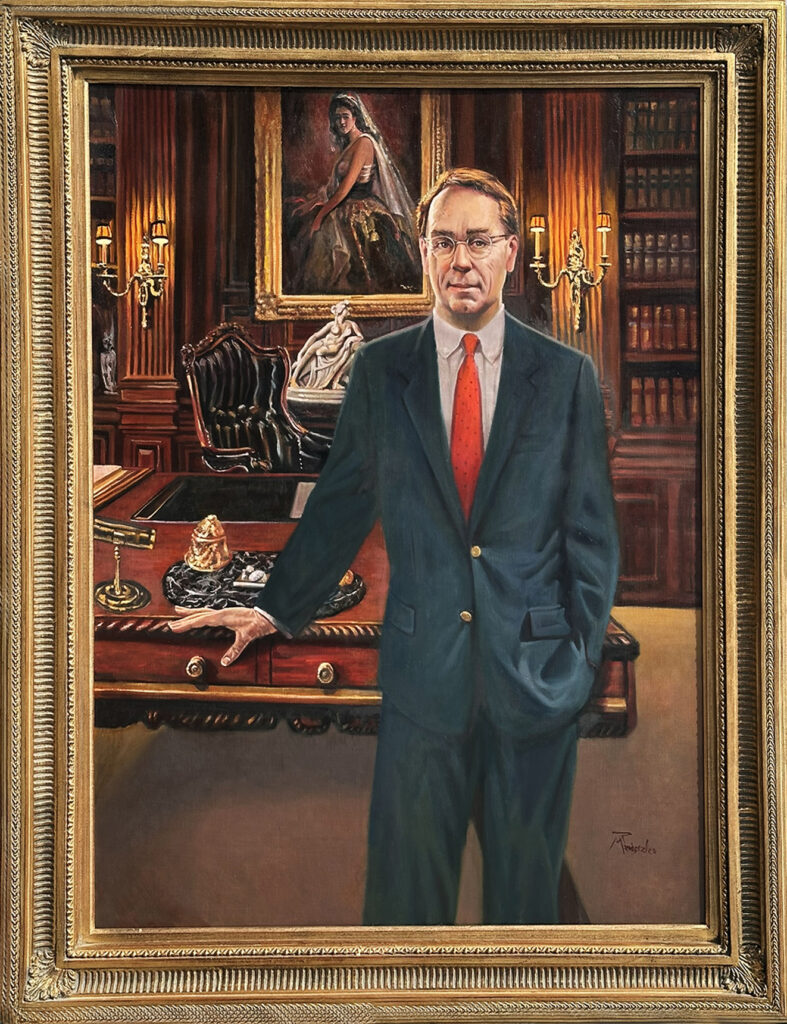
Portrait of Gedney Howe III in main office, designed by Buzz Harper
I am so fortunate to have been able to share some beautiful moments with such amazing people and those who love them. I am extremely honored to have created legacies for such amazing people. Gedney Howe III is one such individual, a man who has given so much to this community as Charleston’s preeminent attorney. I had the privilege of speaking with him briefly before he unexpectedly passed last year. We had planned the portrait to happen while he was with us. Though in mourning, Gedney IV helped me capture the vision he had for his father’s portrait.
Gedney III and I had one very special person in common, the late Buzz Harper, our dear friend and the designer of the interior of this office as well as the Calhoun Mansion, which when it changed hands, sadly lost the distinctive Harper touch. The chair, once owned by President Howard Taft, a beautiful marble and lovely portrait grace the dark would law bookshelves. Formidable, but reassuringly warm. Gedney stands confidently, but again, with a touch of warmth. He cared about the law but he also cared for the people he served so well throughout his storied career.
“I ain’t the real Gedney Howe,” Gedney Howe III says with a laugh, paraphrasing what a friend of his father’s once told him. Despite Howe III’s accomplishments in the courtroom, including successful results for his clients in many high-profile cases, one of which remains South Carolina’s largest-ever personal injury verdict, he doesn’t consider the comment an insult. When your name is Gedney Howe, that talk simply comes with the territory.
The “real” Gedney Howe-or “Big Gedney” as he was called after his son was born – was known across South Carolina for his searing intellect and generous spirit. His father had been a civil engineer, but the second Gedney Howe took up law. Throughout a 60-year legal career, including 10 years as solicitor of the 9th Judicial Circuit, Gedney Howe Jr. was as formidable a trial lawyer as he was a compassionate and engaged citizen. A consummate storyteller with a distinctive Charleston brogue, Big Gedney was revered as the “Sage of the South,” and a bronze bust was built to memorialize him in the courtyard entryway of Charleston’s Judicial Center after his death in 1981. He looked out for the little guy, championed equal justice, and mentored many young lawyers-including one Gedney Howe III.
The younger Howe has never tried to escape his father’s shadow; rather, he embraces it, credits his dad for leading him toward law and acknowledges the leg-up the Howe name has given him.
“My daddy loved being a lawyer. He was having such a good time doing it that it created this gravitational pull for me,” Howe says. “People were always coming up and thanking him for helping them, giving him such positive reinforcement that it seemed to me to be a pretty good way to spend your day. I could see that my daddy had a life well-spent, and that was what really drew me and my brothers and sister toward practicing law.” Indeed, all four Howe offspring followed in Big Gedney’s footsteps, although “Little Gedney,” the second child and oldest son, was the only to go into practice with his father, which he did in 1973. “I was so fortunate that I got to work with my daddy for seven years. It gave me a jump-start; I got to do big cases right away. Not because of me, but because of him,” he says.
Howe earned his J.D. from the University of South Carolina School of Law in 1973; his legal education began much earlier. The Howe children grew up listening to “Howe’s Little Home Lectures,” as they dubbed their father’s dinner-table chats. Conversations that began typically with “How was your day?” segued into case recap, then morphed into eloquent musings on principles of law.
Long before he was a lawyer, Howe was a “doctor,” thanks to his mother. “She was a very substantial person in her own right,” he says. “My mother had a clear sense of right and wrong. When it came to how to treat other people, there was no gray area.” Marybelle Howe devoted her adult life to civil rights causes, including outreach to the farmworkers on the rural sea islands outside downtown Charleston, where the Howe family lived and the kids attended public school. “I fought in the war on poverty-I was a draftee,” Howe quips about his volunteering, recalling how at age 14 he dispensed the worm shots (“I was the ‘doctor,’” he says) when his mother organized a health clinic for the migrant farmers in the early 1960s. “Things were so prejudiced back then that the hospitals wouldn’t even send a medical resident out there.”
Keep reading . . .Gedney M. Howe III – Law Offices of Gedney M Howe III
 Would you like to get inspiration in your inbox, rather than ads for more stuff? Welcome to ManiscalcoGallery.com