
Sacrificial Pelicans
Price range: $95.00 through $1,800.00
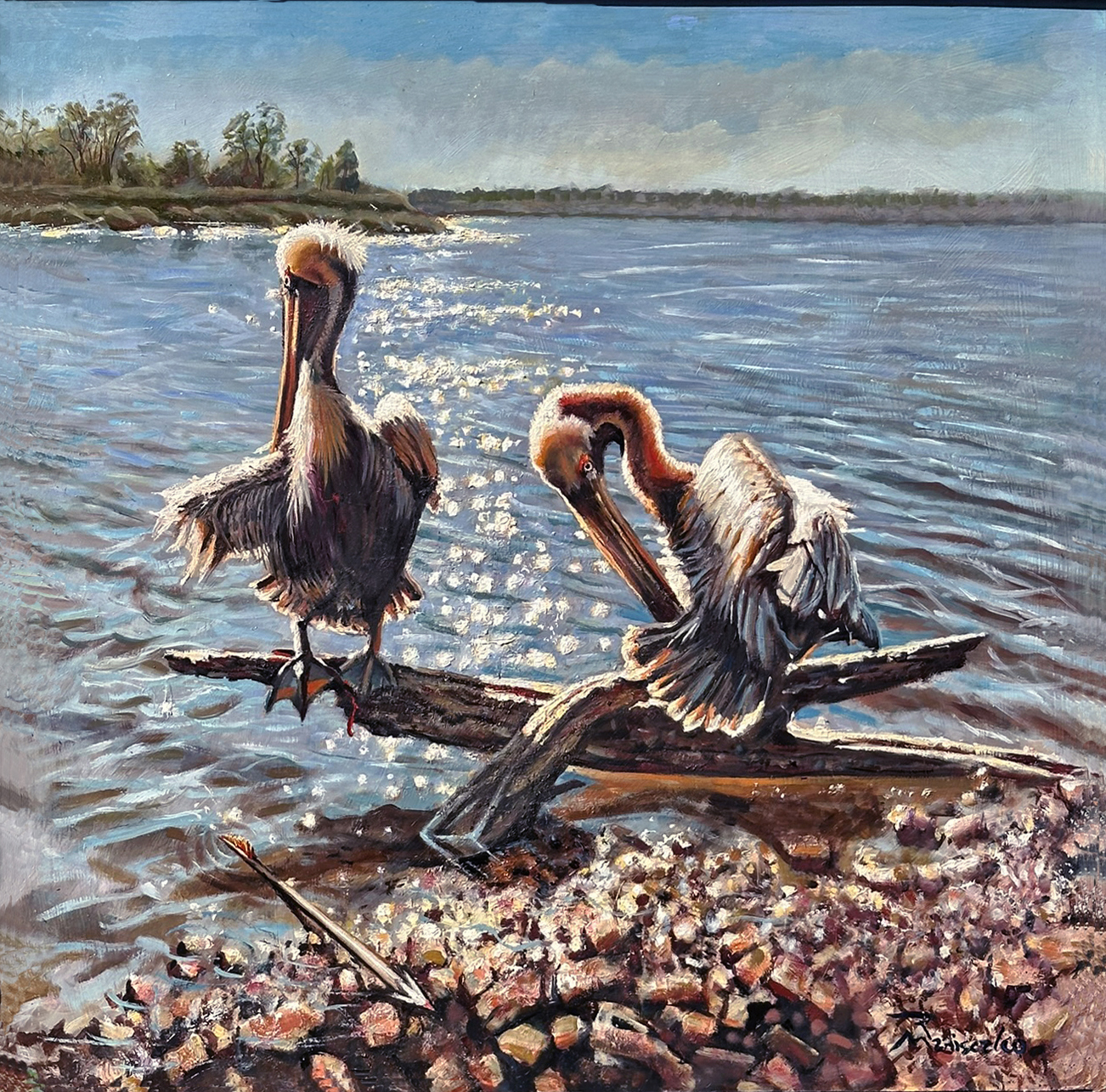
Sacrificial Pelicans 24 x 24″ oil on panel – ready to frame
The symbolism of the Sacrificial Pelican is fascinating indeed. The breast of the Pelican is pierced, and she nourishes her young with her own blood, a symbol of the sacrifice of Christ on the cross. In this painting, two Pelicans interact, the one on the left extending the upper portion of its wing as if opening her breast, accepting her sacrifice, while the other tends to its own grooming. An arrow lay on the ground before us. The glaring light is the light of an almighty, loving God. The sacrifice is for you and me.
Continued . .
The pelican became a symbol of charity. Reference to the pelican and its Christian meaning are found in Renaissance literature: Dante (1321) in the “Paridiso” of his Divine Comedy refers to Christ as “our Pelican.” John Lyly in his Euphues (1606) wrote, “Pelicane who striketh blood out of its owne bodye to do others good.” Shakespeare (1616) in Hamlet wrote, “To his good friend thus wide, Ill ope my arms / And, like the kind, life-rendering pelican / Repast them with my blood.” John Skelton (1529) in his Armorie of Birds, wrote, “Then sayd the Pellycan: When my Byrdts be slayne / With my bloude I them revyve. Scripture doth record / The same dyd our Lord / And rose from deth to lyve.”
The pelican also has been part of our liturgical tradition. The image of the pelican feeding its baby pelicans her own blood was a popular artwork on an altar frontal throughout Europe. In early times, when tabernacles were sometimes suspended over the altar, they were shaped like pelicans: for example, Durham Cathedral, to which was attached a Benedictine monastery prior to the suppression of the monasteries by Henry VIII 1538, had the Blessed Sacrament reserved in a tabernacle fashioned in silver like a pelican and suspended over the High Altar. In the hymn “Adoro te devote,” the sixth verse (written by St. Thomas Aquinas and translated into English by Gerard Manley Hopkins) reads,
Like what tender tales tell of the Pelican
Bathe me, Jesus Lord, in what Thy Bosom ran
Blood that but one drop of has the powr to win
All the world forgiveness of its
There is also in my imagery the reclamation by nature going on in the shoreline, on which the viewer stands, an observer to the forces of nature in motion. The ruins of the Ashley Phosphate factory that once stood in this place, now represented by worn bricks on the shoreline. The scene is about a quarter mile from my home on the upper Ashley River. I happened on it during a tranquil kayak ride with my brother, James, who was in for a visit. The ruins are scattered all through the wooded area and trails nearby. I took some liberties in building the picture, combining elements from several sources. Enjoy this visit from nature and relish in the abundance of light in the spiritual otherworldliness of Sacrificial Pelicans.
You must be logged in to post a review.

Reviews
There are no reviews yet.