
Grant application and EXHIBITION DESCRIPTION
Adventures in Wonderland
A Collaborative Exhibition Proposal of Imaginary Realism · Nick Cerrato and Robert Maniscalco
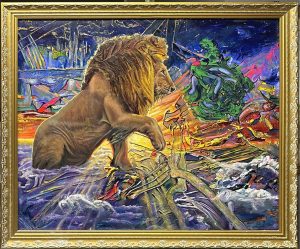 We propose to develop Adventures in Wonderland, a collaborative touring exhibition of Imaginary Realism by Nick Cerrato and Robert Maniscalco. The project combines Cerrato’s physically direct abstract expressionism with Maniscalco’s command of expressive realism to create speculative worlds addressing trauma, disability and mobility, interdependence, survival, isolation, power, environmental precarity, inequality, spiritual longing, and the human need to belong. Imaginary Realism, as we use the term, is related to magical realism and science fiction: recognizable figures, objects, and landscapes enter coherent but impossible worlds where psychological, spiritual, and social realities can become visible. The collaboration does not ask either artist to surrender his visual identity. Instead, it creates a third language that neither could produce alone.
The collaboration began after Cerrato encountered Maniscalco’s painting “Cassandra” at the Piccolo Spoleto Outdoor Art Exhibition in Charleston’s Marion Square. Seeing it from Meeting Street, Cerrato asked his mother to stop so he could examine the work. He was struck by Maniscalco’s ability to communicate complex narrative ideas through convincing realism and soon proposed a collaboration that could help give visual form to stories he wanted to explore. That sent Maniscalco to see Cerrato’s paintings, which happened to be on exhibit at Public Works Art Center in Summerville. He recognized in them a spontaneity and emotional immediacy he had long wanted to release more fully in his own practice. Each artist saw in the other an ability that could enlarge his own work: Cerrato sought Maniscalco’s narrative and representational fluency, while Maniscalco sought Cerrato’s fearless mark-making and freedom from overcontrol. They discovered immediately that they had a deep affinity that translates directly to their symbiotic process.
Collaborative Method
Each painting begins with conversation. Cerrato and Maniscalco identify a question, image, spiritual concern, or narrative situation, then develop a flexible plan through descriptions and sketches. Ideas may originate with either artist. They translate the concept into visual elements, establish a general composition and palette, and decide which artist will direct which physical process. The plan creates coherence without predetermining the image; surprise and exploration remain essential to the process.
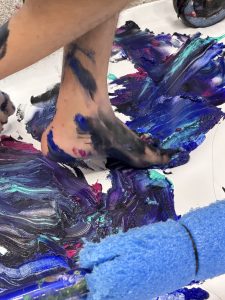
In the first stage, Maniscalco supplies and positions paint in response to the agreed concept and color decisions. Cerrato then strikes, sweeps, drags, and moves the paint with his feet, creating forceful passages of color and heavily worked surfaces. His marks arise from a distinctive physical vocabulary shaped by cerebral palsy, which affects his movement and muscle coordination but does not define his identity or imagination. The exhibition will not treat disability as spectacle or describe Cerrato’s movement as an artistic shortcut. His authorship lies in his decisions about subject, color, force, duration, placement, and when an action is complete. His marks are intentional artistic choices made through the body and abilities he inhabits.
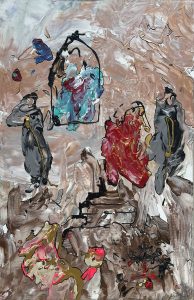
The Throne Room
After the acrylic layers cure, the surface resembles a low relief; the paint is an inch and a half thick in places. Maniscalco studies at this stage, allowing the marks to inspire the next steps. Working through his imaginative doppelganger, NETI, he discovers figures, faces, landscapes, creatures, architecture, and symbolic relationships already suggested by Cerrato’s marks, as well as the initial plan. He then develops these forms and figures with realistic modeling while preserving the initiating gestures. He compares this process to carefully fitting a hand into a glove while trying not to move the glove. The discipline is to clarify and enhance without erasing or negating Cerrato’s powerful mark-making. Cerrato continues to respond as the painting evolves, and both artists decide when it is complete. Authorship remains shared.
Imaginary Realism and Thematic Structure
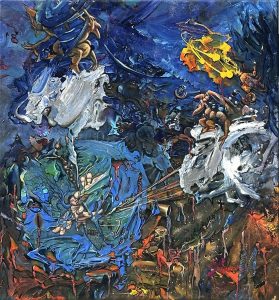
The Great Dilemma 30 x 28″ mixed media
The Great Dilemma demonstrates the possibilities of this process. Across its dense surface, hundreds of suggested features, figures, scenes, and objects surround three principal characters. A figure rises from a fertile but injured Earth, reaching toward two beings in the clouds who appear to judge, bargain, or struggle while remaining tethered to the world below. They may be deities, tricksters, Adam and Eve, good and evil, or conflicting aspects of a God understood as both loving and vengeful. Their ambiguity is central. The painting does not dictate a single allegory; it creates a universe in which contradiction invites sustained looking. Like contemporary reality, it is crowded with competing claims, damaged systems, uncertain authorities, and the persistent possibility of transformation.
The exhibition’s core question is what can imaginary realism and abstract expressionism reveal together when literal representation is inadequate and reality itself is being called into question every day? Cerrato’s concerns include mobility, dependence and independence, Christian faith, and the experience of living in a world organized around bodies unlike his own. Here, we see him reaching out from a wounded Earth. The project will consider how transportation, architecture, social assumptions, care relationships, and access shape his encounters with others. It will also explore his relationship with Jesus and the spiritual meanings he finds in limitation, agency, community, and creation. These concerns will be represented through his own imagery and decisions rather than translated into a generalized story of inspirational disability.
 Maniscalco’s contribution is rooted in his experience of childhood sexual, verbal, and psychological abuse, abandonment, neglect, and the long denial of agency and self-worth. The work will not literally document abuse or turn suffering into spectacle. Its focus is identity and transformation: how terror can take power from a person, how unresolved trauma may shape perception and choices, and how creative practice can support the recovery of voice and agency. Imaginary Realism can embody the contradictions of traumatic experience without reenacting violence. A room may contain incompatible sources of light; a body may hold an architecture of locked doors; water may be life-giving, inaccessible, or dangerous. Such images form a visual grammar rather than a fixed code.
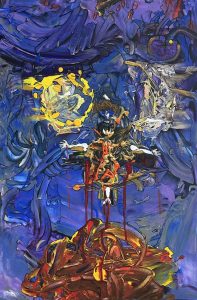
I Tried to Help You 24 x 36″ mixed media on canvas
The exhibition will unfold through five interrelated movements. Silence and the Trusted World will address secrecy, authority, grooming, inaccessible environments, and the destabilization of safety. The Divided Interior will examine isolation, dissociation, bodily constraint, shame, and the mind’s strategies for survival. Voice and Witness will consider disclosure, belief, communication, and passage from separation into relationship. Images may include figures whose shadows speak, witnesses connected by threads of light, or landscapes reorganized by an act of truth-telling.
Quench and the Common Good will broaden the project from personal experience to collective ethics. Building on Maniscalco’s Quench Project and Cerrato’s experience in a mobility-centered society, this section will connect thirst for water with thirst for access, freedom, justice, recognition, safety, and spiritual meaning. It will examine parallels between private harm and public systems without claiming that distinct forms of suffering are identical. The emphasis will be on the mechanisms through which cultures hide deprivation in plain sight, normalize exclusion, and distance privilege from responsibility.
The final movement, More Real Than Real, will turn toward integration, creative freedom, faith, and belonging. It will not offer a simple cure or conventional triumph. Instead, the works will imagine survival as expanded capacity: the ability to hold pain and beauty together, receive and offer help, recognize interdependence, and create meaning without denying complexity. The phrase also describes the aesthetic ambition of the collaboration. The paintings will use impossible worlds to reveal truths that straightforward description cannot contain.
Works, Memoir, and Touring Plan
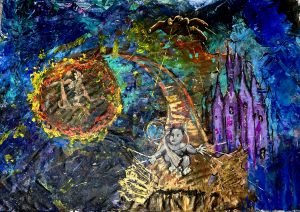
Birthday
We anticipate producing a substantial new body of collaborative paintings, supported by studies, drawings, process documentation, and selected independent works that establish each artist’s development. As of this writing, we have about eight collaborative paintings. Maniscalco’s related material may include portraiture, NETI, Chromo Sapient, courtroom drawings, and The Quench Project. Cerrato’s contributions will demonstrate the evolution of his foot-painted abstract practice and the recurring spiritual, emotional, and social concerns that led him and Maniscalco toward collaboration. The final number and scale of works will be determined through studio development and venue requirements, with a modular design allowing both full and reduced versions of the exhibition to retain a coherent narrative.
Maniscalco’s full-color memoir-in-progress, An Unstill Life, Robert’s seventh book, will accompany the exhibition once it is complete. The approximately 350-page full color publication examines how he moved through childhood sexual and verbal abuse, abandonment, silence, self-loathing, and unhealthy patterns toward a sustainable creative life. The memoir will complement rather than explain the paintings: prose will provide chronology and reflection, while Imaginary Realism will give metaphorical form to experiences that exceed literal narration. Selected excerpts may appear in labels, a catalog, readings, or public programs, while the manuscript remains an independent literary work prepared for publication.
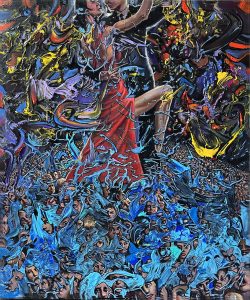
Last Tango in Wonderland 24 x 30″ mixed on canvas
The funding will support concentrated time for research, writing, drawing, compositional studies, reference photography, painting, improvisation, collaboration, revision, framing, shipping and other exhibition logistics. It will also allow Maniscalco to advance An Unstill Life, as a direct dialogue with the visual work. The decisive outcome will be a resolved, tour-ready exhibition; completed interpretive and promotional materials, which may include a short documentary about the collaborative process; a flexible checklist; and a venue prospectus containing representative images, space and access requirements, installation options, and public-program models. Because institutional calendars often extend beyond one grant period, touring will continue for a period of two to three years.
The initial routing strategy will focus on Charleston and the Southeast, including prospective venues such as the Gibbes Museum of Art, Public Works in Summerville, Charleston City Gallery at Waterfront Park, Halsey Institute, and other university galleries, nonprofit art centers, and other institutions committed to contemporary art, disability access, narrative practice, or social engagement. We will also explore Detroit-area venues, connecting the project to Maniscalco’s formative artistic community, and other regions linked to the artists’ lives and work, like New Jersey, where Cerrato has longstanding connections. At this early stage, these venues are prospective rather than confirmed. The completed exhibition and professional prospectus will provide the basis for formal conversations.
Accessibility will be integral to the exhibition rather than appended to it. Venue planning will address wheelchair circulation, seating, accessible label placement, digital or audio interpretation when feasible, and programs that do not require participants to disclose trauma or disability. Public offerings may include joint artist talks, demonstrations of the collaborative process, conversations with artists, disability advocates, survivor advocates, members of the disability community, educators, faith leaders, or mental-health and mobility professionals, and workshops focused on visual metaphor and creative agency. Programs will deepen engagement without reducing the paintings to lessons or case studies. In fact, SC has an accessibility grant with a deadline of 3/27. Accessibility funding is available from numerous sources and I will assist you in researching and executing institutional grant applications, while Nick and I go after individual artist/accessibility funding.
The project is timely because the artists have reached a point of genuine mutual transformation. Cerrato brings an established visual language, a strong conceptual voice, and a bodily form of mark-making that challenges assumptions about intention, control, and artistic mastery. Maniscalco brings more than four decades of technical experience, narrative art, teaching, advocacy, and public engagement. Fellowship and grant support will free the collaboration from the demand that each painting be immediately marketable and allow it to develop at the scale and depth its subjects require. The exhibition will ask what realities society refuses to see, whose bodies and testimony it centers, and what futures become possible when difference is understood not as deficiency but as a condition of relationship. Its aim is a demanding form of hope: art created through trust, reciprocity, and the conviction that two distinct ways of moving through the world can produce a richer shared vision.
Artist Biographies
Nick Cerrato
Nick Cerrato is a South Carolina abstract expressionist whose practice is shaped by an adaptive method of painting with his feet. He began making digital images as a child, but at age twelve, in 2011, he asked his mother for canvases and indicated that he intended to paint with his feet, as he has limited control of his left foot. He has continued painting since then. Cerrato has cerebral palsy, a neurological condition affecting movement and muscle coordination, but his work is not defined by diagnosis. Through decisions about color, subject, rhythm, pressure, and duration, he creates layered, physically immediate paintings marked by sweeping movement and sculptural accumulations of paint.
Cerrato has exhibited at Public Works Art Center in Summerville and has collaborated with other artists to develop narrative ideas that extend beyond a single visual vocabulary. Christian faith, mobility, access, relationship, and the spiritual dimensions of embodied life are central to his developing work. His collaboration with Robert Maniscalco allows his abstract marks to remain materially present while becoming the foundation of complex figurative and speculative worlds.
Robert Maniscalco
Robert Maniscalco is a Charleston-based painter, portraitist, writer, teacher, performer, and survivor advocate. Born in Detroit in 1959, he apprenticed with his father, portrait artist Joseph Maniscalco, and studied clarinet performance, music education, and fine art at Wayne State University. He later trained as an actor at Circle in the Square in New York and made his Carnegie Hall debut in 1992 as a founding member of the New Renaissance Chamber Artists. Since 1980, his commissioned portraits and fine art have entered more than one thousand private and public collections across North America.
Maniscalco founded Maniscalco Gallery in Grosse Pointe in 1997 and hosted two seasons of Artbeat on Detroit Public Television. His bodies of work include Faces of China, Italia, Authentic Sports, Chromo Sapient, Faces of the Lowcountry, Iconic Charleston, and The Quench Project, which grew from a 2015 trip to Haiti and addressed access to safe water. He is the author of six books, including The Fishfly, Point of Art, Chromo Sapient, and The Power of Positive Painting, and he wrote and performed the play Vincent John Doe during Piccolo Spoleto. His NETI persona and Imaginary Realism practice unite classical technique with speculative, dreamlike imagery. His memoir-in-progress, An Unstill Life, connects his creative career to recovery from childhood abuse and abandonment.